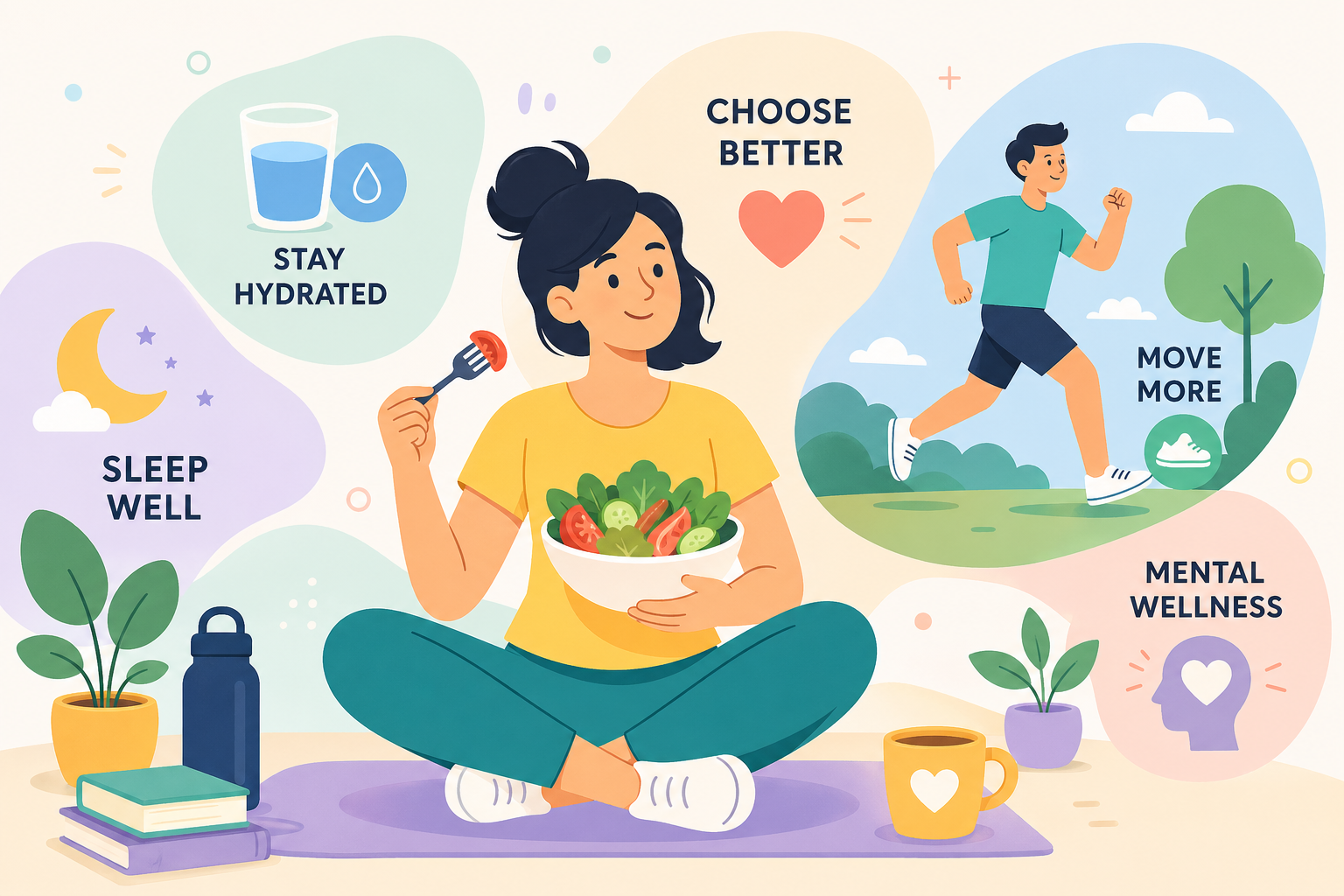
Most people think living healthier means changing everything at once. They sign up for a strict diet, a new gym routine, and an early alarm, all in the same week. By day five, the whole thing has collapsed. If you want to build a healthier life today, the real path is simpler than the fitness industry wants you to believe. It comes down to four foundational pillars: sleep, nutrition, movement, and mindset.
At Fitness Challenge, we’ve watched people transform their health, not through massive overhauls, but through small, consistent changes stacked on top of each other. Small daily improvements in sleep, diet, and activity compound over time into measurable gains in longevity, energy, and chronic disease prevention. This guide gives you a no-fluff, evidence-backed starting point for each pillar, plus a simple framework to build something you’ll actually stick with.
Why Most Health Plans Fail Before Week Two
The problem isn’t motivation. It’s the approach. A well-established model in behavioral psychology holds that attempting multiple large habit changes simultaneously overwhelms the brain’s decision-making capacity and leads to rapid relapse. When everything feels urgent, nothing gets done well. The “all-or-nothing” mindset is one of the most common traps beginners fall into, and it’s surprisingly easy to avoid once you recognize it.
The brain forms habits through repetition in consistent contexts, not through willpower. Research on habit formation (including work by Phillippa Lally and colleagues at UCL) suggests a gym routine requires roughly five to six weeks of repetition before it becomes automatic. Trying to build ten new routines at once means none of them get enough repetition to stick. Smaller commitments have a dramatically higher completion rate, not because they’re easier, but because they leave you enough mental bandwidth to actually follow through.
Start with two habits, not ten. Pick one or two changes and own them before adding more. Fold in another once the first two feel automatic. That’s the strategy the research actually supports, not settling for less, but building something that holds.
How to Start Having a Healthier Life: Sleep First
Every conversation about healthy living tips jumps straight to diet and exercise. Sleep gets treated like a bonus. That’s a mistake, because poor sleep actively undermines every other health effort you make. When you’re sleep-deprived, your food choices get worse, your workout recovery stalls, and your decision-making deteriorates across the board.
The core sleep hygiene recommendations are straightforward. Go to bed and wake up at the same time every day, including weekends. Keep your bedroom cool (around 65°F), dark, and quiet. Eliminate screens one to two hours before bed, the blue light suppresses melatonin production and keeps your brain in alert mode. Get morning sunlight within 30 minutes of waking to anchor your circadian rhythm. These are small healthy habits you can start tonight.
The benefits extend well beyond feeling less tired. Quality sleep reduces systemic inflammation, improves the decisions you make around food, accelerates workout recovery, strengthens immune function, and lowers the risk of depression. A 2019 study published in Nature Human Behaviour found that combining modest sleep improvements with small changes in diet and activity was associated with meaningful reductions in disease risk over time. Fixing sleep is one of the highest-leverage moves a beginner can make. Most sleep hygiene changes cost nothing and pay back across every other pillar.
Nutrition Changes Worth Making First
You don’t need a diet. You need a few high-impact swaps with clear evidence behind them. A 2023 meta-analysis in The Lancet found that adherence to healthy dietary patterns reduces major chronic disease risk by 20 to 42 percent when comparing high to low adherence. That’s a significant number, and you don’t need a rigid meal plan to get there.
Simple Food Swaps That Actually Move the Needle
The swaps with the clearest payoff:
- Replace refined carbohydrates with whole grains to regulate blood sugar and support heart health
- Choose whole fruit over juice to get the fiber that slows sugar absorption
- Shift toward plant-based proteins like legumes, beans, and lentils a few times a week
- Reduce processed meats, which carry preservatives linked to cardiovascular disease and cancer risk
- Replace saturated fats with unsaturated sources like avocado, nuts, and plant-based oils
- Cut ultra-processed foods by choosing minimally processed alternatives whenever possible
Addition Over Restriction
The frame that works better than restriction is addition. Add more vegetables, more legumes, and more whole foods first. When you fill your plate with these, processed food naturally gets crowded out. It’s less psychologically threatening than telling yourself you can’t have something, and it produces the same result. Start with one swap this week. Replace white rice with brown rice at dinner. That’s enough to begin.
How to Begin Living a Healthier Life Through Movement
The CDC and WHO both recommend at least 150 minutes of moderate-intensity aerobic activity per week, plus two days of muscle-strengthening work. That sounds like a lot until you realize it’s 30 minutes of brisk walking, five days a week. A walk around your neighborhood after lunch counts. Taking the stairs counts. The 2018 Physical Activity Guidelines update even removed the requirement that activity occur in bouts of at least 10 minutes, meaning any movement throughout the day accumulates toward the weekly target.
For busy people, “exercise snacks” are a practical solution: short bursts of movement scattered through the day that add up without requiring a dedicated gym block. Ten minutes of bodyweight work in the morning, a 10-minute walk after lunch, and a quick stretch session before bed gets you to 30 minutes without rearranging your schedule.
For beginners who want structure instead of having to figure this out on their own, a goal-oriented, time-bound program removes the daily guesswork entirely. That’s the problem Fitness Challenge’s 30-day programs are designed to solve: no equipment required, clear daily structure, and a defined finish line that helps you stay oriented. Structured programs with clear goals are consistently linked to better adherence in behavior-change research, when you know exactly what to do each day, you spend your energy showing up instead of planning.
The Habit Techniques That Make Changes Last
Four behavior-change methods have the strongest evidence for sustaining new healthy habits: habit stacking, implementation intentions, self-monitoring, and SMART goal-setting. Each one works by reducing the mental friction between intention and action.
Habit stacking means pairing a new behavior with an existing automatic one. Take your vitamins after brushing your teeth. Do a 10-minute walk after lunch. Stretch while your coffee brews. The existing habit provides the cue, so you don’t have to remember or motivate yourself from scratch every time. Implementation intentions take this further by writing specific if-then plans: “After dinner, I will eat a piece of fruit.” The specificity turns a vague goal into a concrete action tied to a consistent context.
Self-monitoring matters even when it feels tedious. Tracking your sleep, meals, or movement, even loosely, builds the feedback loop that keeps habits alive. You don’t need an obsessive logging system. A simple daily check-in creates the awareness that drives adherence. SMART goals do the same thing from the planning side: “Go to bed at 10:30 PM every night” is a SMART goal. “Sleep more” is not. Environment and routine do more work than willpower ever will. Set up the system and let it carry you.
Building Your 30-Day Starter Plan
Here’s how to put this together without overthinking it. Earlier, we recommended starting with one or two habits, that principle applies here. Pick one small habit from sleep, one from nutrition, and one from movement, but keep each one genuinely small. Commit to all three for 30 days before adding anything else. Specific examples: go to bed at 10:30 PM every night, replace white rice with brown rice at dinner, and walk for 20 minutes after lunch. That’s a complete wellness starter plan. It’s not impressive on paper, and that’s the point.
One important note: if you have a chronic condition, are significantly overweight, or haven’t exercised in years, checking in with a doctor before increasing your activity intensity is a reasonable first step. Not because exercise is dangerous, but because a clinician can help you calibrate the right starting point and flag anything worth monitoring.
If you want the fitness pillar handled for you, Fitness Challenge’s structured 30-day challenge programs are built for this moment. They give you a daily plan, remove the decision fatigue, and provide a clear finish line that keeps you oriented. Daily check-ins and a structured peer community keep the accountability built in. You focus on showing up; the program handles the rest.
The Point Is to Start, Not to Be Perfect
A healthier life doesn’t require a dramatic overhaul. It requires picking two or three high-leverage habits, building them into your existing routine, and giving them time to compound. The four pillars reinforce each other in ways that aren’t obvious until you experience them: better sleep sharpens your food choices, better nutrition fuels your workouts, and regular movement deepens your sleep. Pull on one thread and the others follow.
If you’ve been wondering how to start having a healthier life, here’s the honest answer: pick one habit from this guide, be specific about when and how you’ll do it, and commit to it for 30 days. That’s the whole plan. Simple doesn’t mean easy, but it means sustainable. And sustainable is the only kind of healthy that actually counts.
Leave a Reply