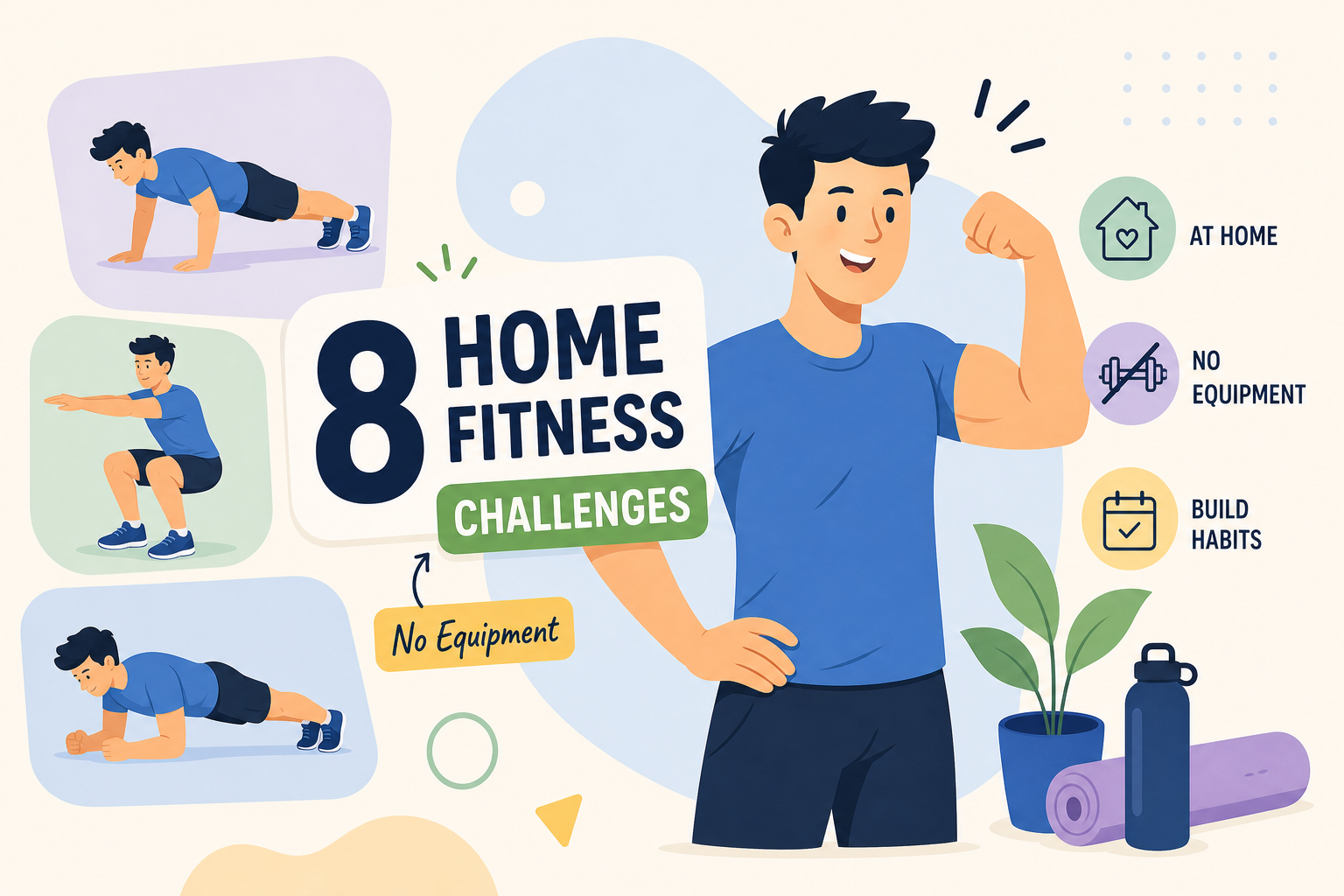
If you’re looking for the best home fitness challenges for beginners with no equipment, you’re in the right place. These are eight bodyweight-only programs, no dumbbells, no bands, no gym membership, with clear end dates and a realistic daily ask. Our editorial team reviewed and rated dozens of no-equipment home workout challenges, filtering out anything with weak progressions, vague instructions, or structures that collapse before day ten. What’s left are plans that actual beginners can start and finish.
Below you’ll find eight programs rated by difficulty, daily time commitment, and results focus. Each one is built for true beginners or anyone who has started and stopped before. Pick one today, not next Monday.
How we rated each program on this list
Every pick here was evaluated on three criteria: difficulty level (true beginner or beginner-moderate), daily time commitment in minutes, and results focus, covering habit building, fat loss, strength, or endurance. A fourth factor shaped the rankings too: dropout risk. Research on exercise adherence consistently shows that a program you quit on day four delivers less than an easier one you actually finish. That’s not a soft opinion, it’s the practical reality of building a fitness habit from scratch.
“No equipment” means exactly that: bodyweight only, no dumbbells, no resistance bands, no pull-up bars. All eight programs work with a patch of floor space and nothing else. Modifications for common limitations like knee pain, wrist pain, and poor balance are covered in a dedicated section later in this article.
Best home fitness challenges for beginners with no equipment: 7-, 14-, and 30-day picks
The eight programs below are organized by duration so you can match the commitment level to where you actually are right now. Start short if you’ve never finished one before. Move to longer formats once you have a week under your belt.
The 3 best 7-day challenges to start this week
A seven-day plan is a smart entry point for anyone who has never finished a fitness program before. The commitment feels manageable, the end date is visible, and early momentum tends to build within the first week. If you’ve tried longer programs and quit, start here.
1. Fitness Challenge beginner bodyweight program (top pick)
Difficulty: Beginner | Time: 20 min/day | Focus: Full-body habit building
The Fitness Challenge beginner plan gives you a clear day-by-day workout built around squats, push-ups, planks, and glute bridges, with progressions mapped out from the start. You begin with wall push-ups and advance to knee push-ups and then full push-ups across the week. Nothing is left ambiguous.
Each 20-minute session burns roughly 90 to 120 calories for a 150-pound adult at moderate intensity, depending on bodyweight and effort level. Many beginners notice improved consistency and an initial strength baseline after the first week. The community feed on Fitness Challenge adds a social accountability layer that most standalone plans skip entirely, and staying visible to others is one practical reason people follow through rather than dropping off.
2. 7-day full-body split (bodyweight focus)
Difficulty: Beginner | Time: 20, 25 min/day | Focus: Muscle activation and endurance
This plan uses a rotating daily split rather than repeating the same circuit. Day one covers full body, day two targets abs and legs, day three shifts to upper body, and so on through a HIIT rotation by day seven. The variety is useful when motivation is still fragile in week one and daily repetition starts to feel like a grind.
This option suits someone who finds sameness mentally draining. The tradeoff is that the rotating format requires slightly more mental tracking of which day you’re on. Keep a simple log and it’s a non-issue.
3. 7-minute daily standing HIIT challenge
Difficulty: Beginner-Moderate | Time: 7, 10 min/day | Focus: Cardio and fat loss
One circuit, repeated daily for 7 days: high knees, mountain climbers, oblique twists, squat and punch, side leg lifts, and plank knee drives. Each move runs for 30 seconds with a 10-second rest. The whole session takes under 10 minutes. For busy adults who can only carve out a single dedicated slot in the day, this is genuinely doable.
It also pairs well as a complement to the Fitness Challenge program above. Run the 7-minute circuit as a short second session on full-body days if you want to increase weekly cardio output without adding significant recovery demand.
The 2 best 14-day challenges for building real momentum
Many people find two weeks to be a useful middle ground between a short sprint and a longer commitment. By day 14, you have a fitness baseline to compare against day one: more reps, longer holds, lower perceived effort. Both plans below are no-equipment, beginner-friendly programs that progress logically from week one to week two without requiring you to design anything yourself.
4. 14-day progressive bodyweight challenge
Difficulty: Beginner | Time: 20, 25 min/day | Focus: Strength and endurance
Run the 7-day full-body template twice, with a built-in progression on day 8. Add 2 to 5 reps to each exercise and extend plank holds by 10 to 15 seconds. That’s it. The plan does the thinking for you, which removes one of the biggest reasons people abandon home programs: decision fatigue.
This is the natural next step for anyone who just finished a 7-day plan and wants to keep going without switching programs. The familiar exercises reduce the learning curve, and the added volume on day 8 is enough to keep progress moving.
5. 14-day push-up and plank focus challenge
Difficulty: Beginner-Moderate | Time: 15, 20 min/day | Focus: Upper body and core
This plan runs daily push-up and plank progressions, starting from modified variations and building toward full versions by day 14. Day one starts with knee push-ups and forearm planks. By day 14, you’re working toward full push-ups and standard planks held for longer durations. The proposed progression moves plank hold time from around 20 seconds toward 45-plus seconds, and push-up reps from roughly 5 toward 15 or more, though individual results will vary based on your starting point.
The focused nature of this plan makes it an excellent pairing with a squat or lower-body program running in parallel. Keep the sessions short and separate them by a few hours if you’re stacking two programs in the same day.
The 3 best 30-day no-equipment programs for visible results
Thirty-day programs are where visible, measurable results become realistic. Consistency across those 30 days matters far more than intensity on any single day. All three picks below follow a 4-week progressive arc: base week, build week, intensity week, and finisher week. They require nothing but floor space and 25 to 30 minutes per day. Calorie estimates run roughly 150 to 200 calories per session at moderate intensity, with higher outputs during finisher weeks, depending on bodyweight and effort.
6. 30-day beginner full-body workout plan
Difficulty: Beginner | Time: 25, 30 min/day | Focus: Total body strength and habit
Week one establishes base reps across squats, lunges, push-ups, glute bridges, and planks. Week two adds roughly 10 percent more reps across the board. Week three introduces additional sets and faster movement tempo. Week four finishes with short HIIT circuits layered on top of the now-familiar exercises. One active rest day per week, structured as a 10,000-step walk or light stretching, is built into the schedule.
This is the most complete standalone plan on the list for a total beginner. The progressive overload is gradual enough to reduce injury risk and meaningful enough to drive real adaptation across the month.
7. 30-day squat challenge
Difficulty: Beginner | Time: 10, 15 min/day | Focus: Lower body strength
A daily squat rep ladder that starts at 25 reps and climbs toward 200-plus by day 30. Note that very high daily rep counts aren’t appropriate for everyone, if volume feels excessive, scale back and progress at your own pace. The format is simple, the time commitment is low, and the lower body conditioning is real when form stays consistent. Safe mechanics throughout are non-negotiable: hips push back before the knees bend, knees track over the feet without collapsing inward, and weight stays through the heels on the way back up.
This plan works best as a supplemental layer on top of a full-body program rather than a standalone routine. Run it alongside the 30-day full-body plan above for a well-rounded month of training that hits every major muscle group.
8. 30-day couch-to-fitness circuit challenge
Difficulty: Beginner-Moderate | Time: 20, 30 min/day | Focus: Fat loss and endurance
This is the most structured option for someone starting from zero fitness. The format alternates workout days with active recovery days and rotates through five movement patterns: push, pull, squat, core, and cardio. Built-in deload days on day 7, 14, and 21 reduce accumulated fatigue and make the 30-day arc sustainable rather than punishing.
People who respond well to challenge-based formats with a clear finish line tend to get the most out of this program. The rotating circuit keeps daily sessions from feeling repetitive, and the deload structure helps prevent the burnout that derails most 30-day attempts in week three.
Modifications so nothing stops you from starting
Physical limitations are real, and ignoring them is how beginners get hurt and quit. These specific swaps keep every plan on this list accessible without skipping the exercise entirely. One general rule applies across all of them: mild muscle soreness is normal and expected; sharp joint pain means stop immediately and regress to an easier variation.
Knee pain modifications
Swap deep squats for half squats, bending only 10 to 45 degrees at the knee. Replace forward lunges with reverse lunges, stepping back rather than forward reduces shear force on the front knee. Swap any jump variations for step-outs. Adding glute bridges and calf raises to your warm-up strengthens the muscles that support the knee joint over time.
Wrist pain modifications
Replace flat-hand planks with forearm planks, keeping elbows directly under your shoulders. For push-ups, elevate your hands on a sturdy chair, countertop, or step to reduce the angle of wrist extension. Fist push-ups or push-up handles are also effective options. The goal is a neutral wrist position throughout every weight-bearing movement.
Balance modifications
Use a chair or wall for any single-leg movement. For squats, try a box squat variation where you sit back to a bench or chair, this controls depth and removes balance demand entirely. Progress to unsupported versions only when you feel fully stable through multiple supported sessions.
How to track progress and actually finish what you start
Tracking doesn’t require an app, a spreadsheet, or a fitness tracker. Three simple methods cover what a beginner actually needs: a workout journal logging reps, hold times, and RPE scored from 1 to 10; weekly benchmark tests checking max push-ups and max plank hold time; and timed AMRAP circuits measuring how many rounds you complete in 10 minutes. Limit yourself to three metrics at most, more than that and progress monitoring becomes its own project.
Illustrative 30-day benchmarks for a consistent beginner might look like this: plank hold improving from 20 seconds toward 60 or more, push-ups climbing from 5 reps toward 20-plus, and perceived exertion on the same workout dropping from 8 out of 10 to around 5. These are realistic targets, not guarantees, individual results depend heavily on starting fitness level and consistency. That last number is often the most satisfying because it reflects genuine physiological adaptation.
The weekly benchmark test (3 exercises, 5 minutes)
Once per week, test three movements: max push-ups in one set, max plank hold time, and max squat reps in 60 seconds. Record the numbers, run the same test the following week, and compare. That’s your progress data. No gym required, no scale needed, and the test itself takes under 5 minutes.
Using RPE to know when to progress or pull back
Rate your effort from 1 to 10 after each session. A 7 or 8 means the plan is appropriately hard. A 9 or 10 across multiple sessions in a row signals you need a recovery day. A 4 or 5 means it’s time to add reps, sets, or time. RPE gives you real-time feedback without overthinking the numbers, and it accounts for variables like sleep and stress that objective metrics miss entirely.
Start today, not next Monday
The best no-equipment home fitness challenge for beginners is the one with a clear start date, a daily time commitment you can actually keep, and a difficulty level honest enough to survive the first week. That combination is rarer than it should be, which is exactly why most people abandon fitness programs before they see results.
The Fitness Challenge beginner program earns the top spot on this list because it addresses the two things that most commonly derail beginners early on: vague progressions and no accountability. A day-by-day structure and an active community give you a better shot at finishing day 7, and day 30, than going it alone with a generic plan. Pick one of the best home fitness challenges for beginners with no equipment from this list and start it today. Browse the full library of no-equipment beginner programs at Fitness Challenge and find the format that fits your schedule.
Leave a Reply