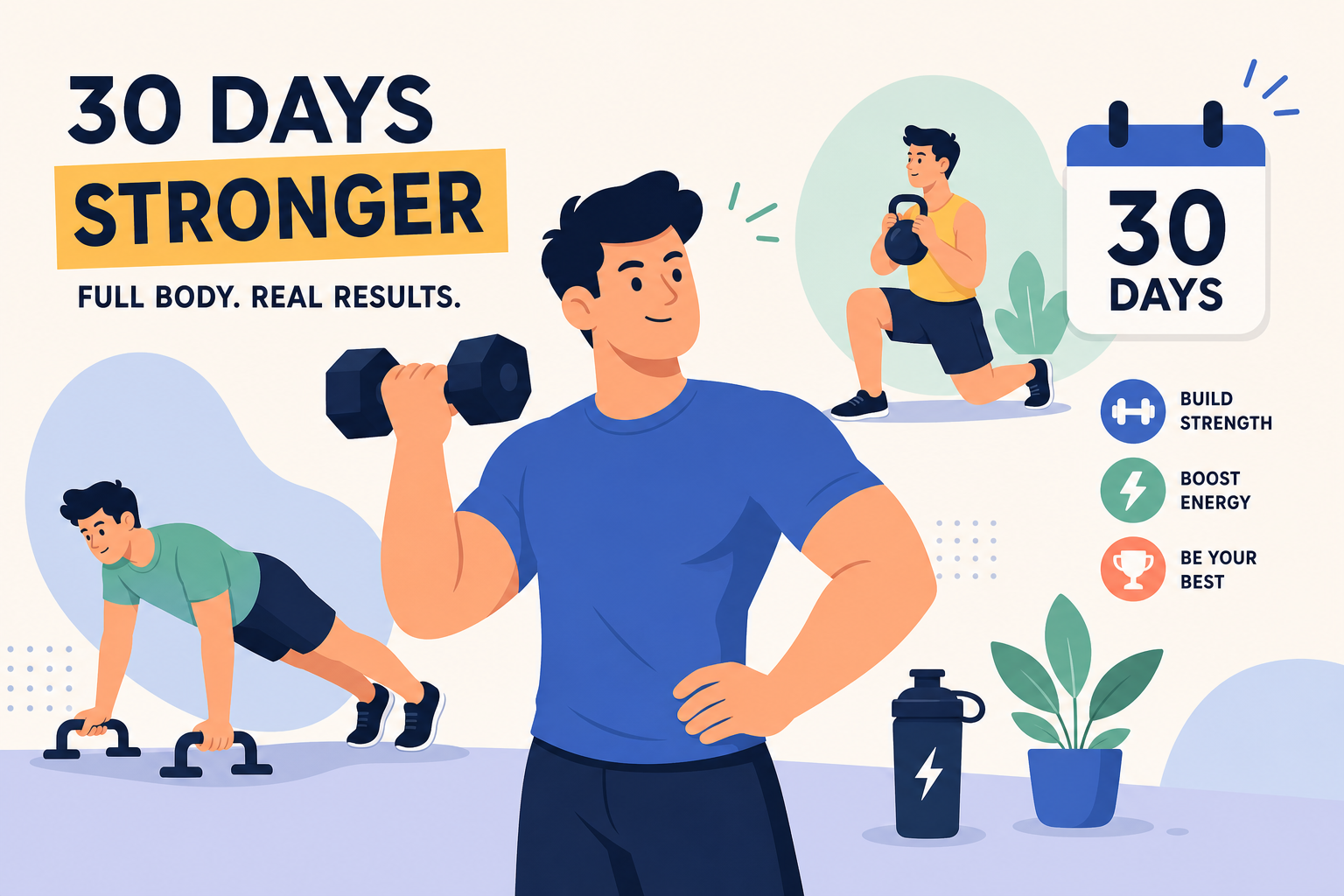
A full body workout challenge works because it solves three problems at once: it gives you a defined timeframe, a daily purpose, and a clear endpoint. Most people don’t abandon fitness programs because they lack motivation, research consistently shows that poor adherence stems from a lack of structure and unclear goals. Without knowing what to do, when to do it, and how hard to push, effort scatters. A structured 30-day program locks all of that in from day one. Fitness Challenge is built specifically to make that structure accessible, no personal trainer required, no years of experience assumed.
This article covers what a 30-day total-body program actually involves: which muscle groups get trained, how to split your week, how intensity builds across four weeks, and what results you can realistically expect when you see it through.
What a full body workout challenge actually means
A genuine full body workout challenge hits every major muscle group in each session, not just the ones you feel like training that day. Sessions typically run 30 to 60 minutes depending on structure, and happen three days per week on non-consecutive days, giving your muscles at least 48 hours to recover between rounds. Over 30 days, that adds up to roughly 12 sessions: enough stimulus to drive real adaptation without grinding your joints into the ground.
The challenge format removes decision fatigue. You don’t choose what to do each morning. You don’t wonder whether you trained enough yesterday. You follow the plan and move on with your day. That clarity is what separates people who make consistent progress from people who show up without a real plan. Structured programs improve adherence precisely because they remove the daily negotiation with yourself. Commitment over perfection, every time.
The muscle groups a full body routine targets
Upper body: push and pull movements
Every session should cover both pushing and pulling. Pushing movements, push-ups, bench press, and overhead press, develop the chest, shoulders, and triceps. Pulling movements, like rows and pull-ups, build the back and biceps. Training both sides in the same session supports better posture and long-term shoulder health; consistently neglecting one side can contribute to muscular imbalances that accumulate over time.
Lower body and core: the foundation
Squats, deadlifts, and lunges handle the quads, hamstrings, and glutes. Planks, mountain climbers, and anti-rotation exercises train the core. The core isn’t just your abs; it’s everything that stabilizes your spine when you squat, press, or pull. Train it as the foundation it is, not an afterthought bolted onto the end of a session.
Why compound exercises dominate this format
Compound movements work multiple muscle groups simultaneously, which is exactly what a 30 to 60 minute daily workout program demands. A squat trains quads, glutes, and core at once. A row hits the back, biceps, and core together. For anyone running a bodyweight full-body challenge at home with no equipment, compounds like burpees and push-up variations deliver the same multi-muscle benefit; see this guide to at-home workout routines for training without a gym. The efficiency isn’t a compromise; it’s the point.
Full body workout challenge: 30-day training schedule
The A/B training split explained
Two workouts, alternated across three non-consecutive days per week. Workout A covers the push and pull pattern: squats, bench press, bent-over rows, overhead press, and Romanian deadlifts. Workout B balances lower and upper: conventional deadlifts, lunges, pull-ups (or inverted rows as a regression), incline push-ups, and bicycle crunches. Alternating A and B three times per week gives you 12 sessions over 30 days without repeating the same stimulus back to back. This is the kind of structure you’ll find in many 30-day full-body workout plans.
A week-by-week progression framework
Four weeks, four phases, each one building on the last.
- Week 1 (base): 3 sets, 6, 8 reps, conservative loads. Learn the movements before you load them.
- Week 2 (endurance): Same weight, push toward 8, 10 reps, and reduce rest periods slightly.
- Week 3 (strength): Increase load by 5, 10%, return to 6, 8 reps, and add a three-second controlled descent.
- Week 4 (peak): Match Week 3 load, target 8, 10 reps, then deload the final two to three days.
This arc mirrors how the body adapts: movement quality first, then load. Skipping the base phase and jumping to heavy weights in week one is one of the most common mistakes beginners make.
Rest days and active recovery
Rest days are not optional. Muscle repair requires at least 48 hours between sessions targeting the same groups, that’s where genuine adaptation happens. On off days, walk or do light mobility work. Sleep seven to nine hours. Skipping recovery doesn’t make you tougher; it just slows your results.
Progression strategies for beginners, intermediates, and advanced lifters
Beginner progression: build the base first
Start at three sets of 8, 12 reps with three to four reps left in the tank. The weight should feel manageable, not maximal. In weeks one and two, movement quality matters more than load. Add reps first. When you consistently hit the top of the rep range with clean form, increase weight by five to ten percent. Jumping the load too soon is how beginners stall before they’ve barely started. For an expanded primer, see this beginner training guide.
Intermediate progression: add volume and intensity
Intermediates can handle four to five sets per exercise, mixing five-to-ten rep strength work with eight-to-twelve rep hypertrophy sets. Push to RPE 8, 9 by weeks three and four. Keep in mind that rest intervals depend on the goal: conditioning-focused circuits benefit from shorter rests of around 60 seconds, while heavier strength sets warrant 90 to 120 seconds to maintain performance. Compound lifts should show measurable progress over the month; if you’re not moving forward, review your load, volume, and recovery before assuming you’re working hard enough.
Advanced progression: periodize to keep moving forward
Advanced lifters won’t gain in a straight line, and any program promising otherwise is overselling. Use lower rep ranges (three to six reps) at higher loads in weeks three and four, taper volume before testing for new personal records, and rotate exercise variations to prevent adaptation. The A/B split still works, but intensity is managed through load percentage rather than rep count alone.
Equipment and no-equipment options for every exercise
Bodyweight regressions for beginners at home
Every exercise in this program has a regression. Push-ups drop to knee push-ups or incline push-ups on a chair. Squats become chair squats or wall-assisted squats. Lunges turn into stationary split squats. Planks start from the knees. Anyone can start this full body workout challenge with zero equipment and zero gym access. That’s not a workaround; it’s a legitimate starting point with a clear path forward.
At-home full body workout challenge: progressions without weights
When bodyweight feels easy, the answer isn’t always adding load. Increase difficulty through tempo (a three-second slow descent doubles time under tension), unilateral loading (single-leg or single-arm variations), or leverage shifts. Archer push-ups, pistol squat progressions, Bulgarian split squats, and inverted rows under a sturdy table all represent genuine full-body exercise circuit progressions that require zero equipment. The body responds to mechanical challenge, not the source of it.
When to add dumbbells or a barbell
If you have access to basic equipment, consider introducing dumbbells around weeks two and three for goblet squats, Romanian deadlifts, and overhead presses, this timing gives you a movement foundation before adding external load. A barbell unlocks conventional deadlifts and back squats for significantly greater loading potential. No gym access? Fill a backpack with books. The progression principles stay the same regardless of what’s in your hands.
What results to expect after completing a 30-day challenge
Strength and endurance gains you can measure
After 30 consistent days, beginners typically add five to ten reps to exercises they could barely finish on day one. Plank holds often jump from 20 to 30 seconds up to 45 to 60 seconds. Sessions that felt exhausting in week one feel manageable by week four. These early gains are largely neural adaptations: your nervous system learns to recruit muscle more efficiently before significant muscle mass is even added. That’s real progress, even if the mirror doesn’t show it yet.
Body composition: honest expectations
Visible fat loss in 30 days depends heavily on what you eat. With a slight calorie deficit and consistent training, a one to three pound reduction in body fat is a realistic target for most people, though individual results vary based on starting point and nutrition adherence. Muscle definition becomes noticeable, particularly in the arms and core. Don’t expect a dramatic transformation after one month; do expect to feel and move noticeably differently. Track with photos, weekly measurements, and max-rep tests on days one, fifteen, and thirty. Numbers don’t lie the way mirrors do.
Using a structured program instead of building from scratch
Designing your own weekly split, managing progressive overload, and selecting the right exercise regressions for your level takes significant time and knowledge most people don’t have when they’re just starting. That’s exactly the gap Fitness Challenge’s full-body programs are designed to fill, progressions, rest days, and level-appropriate exercise swaps already mapped out, so you can focus on showing up instead of planning. The full-body programs there lay everything out from the first session to the final deload day, every session accounted for, every progression mapped. You can also compare other examples like the 30-day fitness challenge.
The bottom line
A full body workout challenge works because it provides structure, not just inspiration. Train every muscle group, follow a periodized split, scale the exercises to your fitness level, and track your results week by week. Thirty days won’t transform your body overnight, but it will build a real habit and give you measurable proof that consistent, structured training works.
If building your own program from scratch sounds like too much, that’s what Fitness Challenge is built for. The full-body programs there lay everything out from the first session to the final deload day, every session accounted for, every progression mapped. Pick your start date and begin.
Leave a Reply